Of everything a person can do to sleep better, morning light is the one with the best ratio of effect to cost. It requires no device, no purchase, and no discipline beyond going outside. And yet it is the input most people skip, because it competes with the phone for the first minutes of the day and usually loses.
This protocol is simple to state and easy to underrate: get bright light into your eyes early, preferably daylight, preferably before you start scrolling. What follows is why that works, how much light you actually need, and where the popular version of the advice overshoots the evidence.
What it is
Timed exposure to bright light in the first part of the day, used deliberately as a signal rather than incidentally. In practice that means stepping outside, sitting by a bright window, or—when the sun is not up yet—using a bright artificial light for a set period after waking.
It is the daytime half of a pair. The companion move is dimming light in the evening; the two work in the same direction, one telling the body it is day and the other letting it recognize night. This page covers the morning side, which pairs naturally with the lighting guide and with a consistent wake time.
Where it came from
The idea is old as a folk practice and recent as a mechanism. Bright-light exposure has been used clinically for decades to treat seasonal and circadian sleep disorders. What changed is the discovery, in the early 2000s, of a class of retinal cells that respond to light not for vision but for time—feeding the brain's master clock in the suprachiasmatic nucleus. That finding turned “get some morning sun” from advice into a described pathway.
Why people use it
The claims usually attached to morning light are faster sleep onset at night, steadier daytime energy, better mood, and a more stable wake time. Some of that is well supported and some of it is enthusiasm; the sections below separate them.
What happens physiologically
Light is the dominant zeitgeber—the environmental cue that sets the human circadian clock. Specialized cells in the retina detect ambient brightness and signal the suprachiasmatic nucleus, which in turn coordinates the timing of hormones, body temperature, and alertness across the day. Light early in the biological morning nudges the clock earlier; light late at night pushes it later. The size of the signal depends heavily on intensity, which is where indoor light falls short: a bright room is a few hundred lux, while an overcast morning outdoors is thousands, and direct sun is tens of thousands.
What the evidence supports
That light is the primary regulator of circadian timing is not controversial—it is the consensus view in the field, and the review by Blume and colleagues lays out the pathway and the effects on sleep and mood. The practical implication, that more daytime light and less nighttime light support better-aligned sleep, follows directly.
The applied evidence is encouraging but more modest than the internet suggests. In one study of office workers, those with more daylight exposure slept longer and reported better sleep quality and vitality than colleagues in windowless spaces. That is a small study, and it measured overall daylight rather than a timed morning dose, so treat it as consistent with the mechanism rather than proof of a specific routine.
What the evidence does not support
The strong version of this advice—that a precise number of minutes of morning sun will reset your rhythm, raise daytime dopamine, and fix your sleep on its own—runs ahead of what has been demonstrated in controlled human studies. The specific dose-response popularized online (exact minutes at exact times, with or without sunglasses) is a reasonable rule of thumb, not an established prescription. Morning light also does not override a chaotic schedule: if your wake time swings by hours, the light signal is fighting a moving target. It is a foundation, not a cure, and it works best stacked with consistent timing and a dark, cool bedroom.
How to use it
- 1Within an hour of waking, get outside. A few minutes on a clear morning, longer if it is overcast — outdoor light is far brighter than it looks, and the eye adapts and hides that from you.
- 2Let the light reach your eyes. Don't stare at the sun, and don't wear sunglasses for this window. Regular glasses and contacts are fine.
- 3If it helps, stack it with something you already do: coffee on the porch, a short walk, walking the dog.
- 4In winter or before sunrise, substitute a 10,000-lux light-therapy lamp for 15–30 minutes at arm's length while you get going.
- 5Keep the wake time steady day to day. The light signal is only as useful as the schedule it reinforces.
How the home enables it
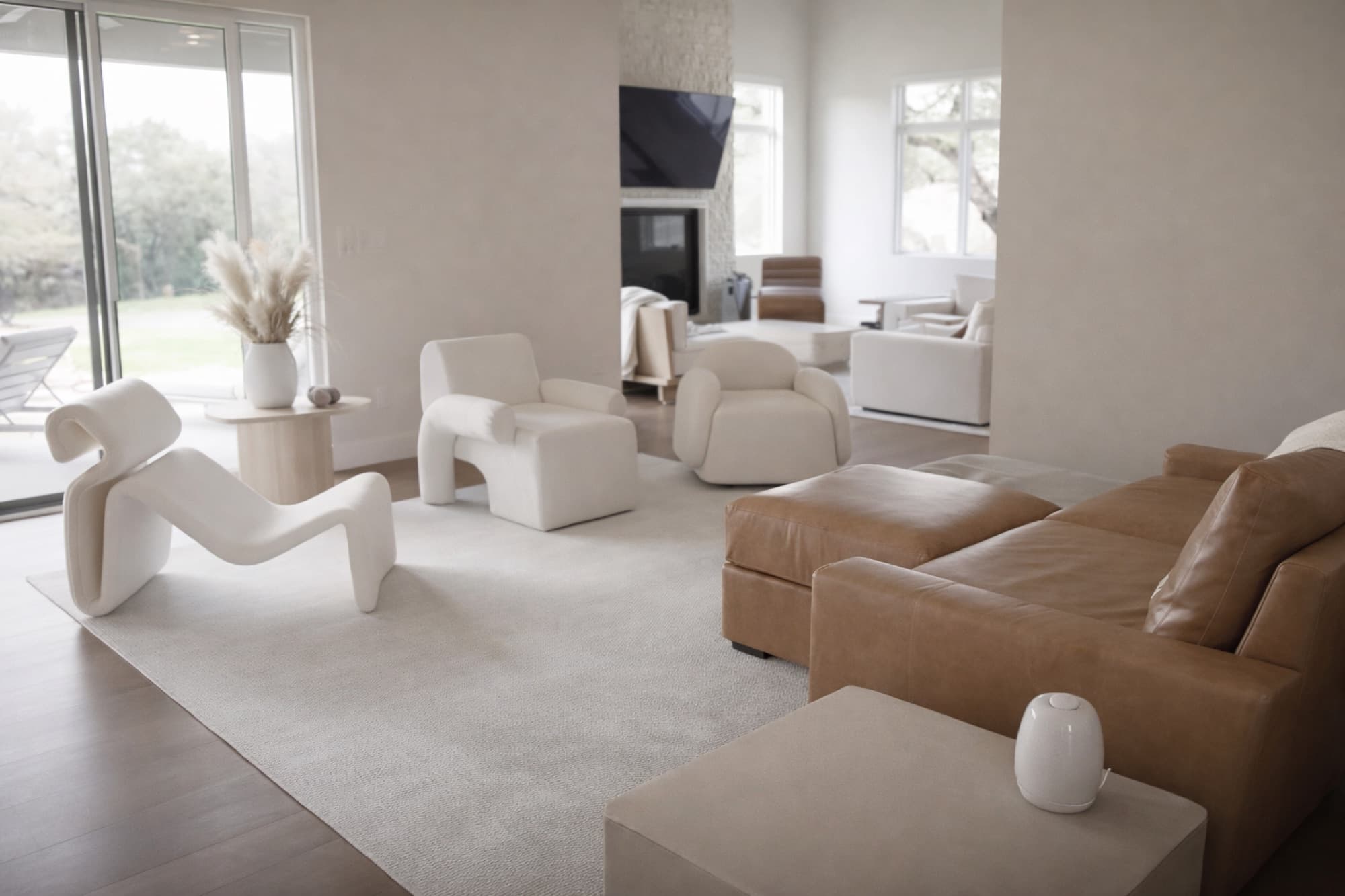
This is where a house helps or quietly sabotages the habit. East-facing glazing in the rooms you occupy first — kitchen, breakfast area, bathroom — turns morning light into something you get by default rather than something you have to schedule. Deep floor plans work against it: daylight from a side window falls off sharply a couple of dozen feet in, so a bright-feeling interior can still be circadian-dark.
A few design decisions do most of the work. Put a chair where the morning sun actually lands. Keep an unobstructed path to a door or balcony so “go outside” has no friction. Where architecture can't deliver morning sun—a north-facing bedroom, a dark winter climate—program circadian lighting to run bright and cool in the morning as a backstop. The point is to make the correct behavior the easy one.
Risks and contraindications
Low risk for most people. Never look directly at the sun. People with eye conditions, those on photosensitizing medications, and anyone with bipolar disorder (where bright-light timing can affect mood episodes) should check with a clinician before adding structured light exposure. Bright-light therapy lamps should be UV-filtered.
The compressed version
Outside, eyes open, no sunglasses, within an hour of waking, most days. A few minutes when it's sunny, a bit longer when it's grey. Steady wake time. A therapy lamp only when the morning is genuinely dark. That is the whole protocol.