
Why Light Matters
Most homes are designed to look good in photographs. Very few are designed around how a person actually experiences light from sunrise until bedtime — and the difference between those two design briefs is the subject of this guide.
Light is the primary timing signal for the human circadian system. The body's master clock is set largely by light reaching the eyes, and the research here is unusually consistent: bright days and dark evenings support sleep timing, alertness, and mood, while the reverse — dim days and bright evenings, which is how most homes operate — works against all three. In one controlled study, ordinary room light in the hours before bed delayed melatonin onset in nearly every participant and shortened its duration by about 90 minutes.
But the health story is only half of it. Light is also how you see — task lighting decides whether the kitchen knife work and the bathroom mirror actually function — and it is the single strongest lever on how a room feels. The same space reads as a lab, a restaurant, or a cave depending on where the light comes from, what color it is, and what it lands on. A home that gets light right is doing architecture, atmosphere, and physiology with the same system.
The organizing idea of this guide: light is a system with a daily schedule, not a collection of fixtures. Sun through windows is one layer, electric light is several more, and the goal is for all of them to agree about what time of day it is.
The Numbers
Natural Light First
No fixture competes with the sun. Even on an overcast day, outdoor light is an order of magnitude brighter than a well-lit interior — which is why a week of camping resets circadian timing faster than any product. The first questions in lighting design are architectural, and they're free to ask even if the answers cost money.
Orientation and exposure. Which way the main living spaces face decides the character of the light all day: east gets the morning light your circadian system wants, south (in the northern hemisphere) delivers steady, controllable light through the day, west brings warm but low, glare-prone afternoon sun, and north gives soft, even, shadowless light — prized for studios, hard on solar gain. In a new build, putting the kitchen and primary bedroom on the morning side is one of the highest-leverage decisions available. In an existing home, it tells you which rooms to assign to which hours.
Windows and skylights. Glazing area sets how much daylight gets in; head height sets how deep it travels — a taller window lights more of the room than a wider one of the same area. Daylighting practice treats windows as light sources to be designed, not holes to be maximized: light from two sides kills glare better than more light from one side, and a skylight or clerestory can pull daylight into the interior rooms a floor plan otherwise abandons.
Shading and seasonality. The sun moves; the house shouldn't fight it in July and starve in January. Overhangs sized to the summer sun angle, exterior shades, and interior shades — ideally motorized, so they actually get used — turn glazing into an adjustable system. Seasonality matters indoors too: winter mornings may need electric light to do what the sun did in June.
Views and reflection. What daylight lands on decides what the room does with it. Light floors and ceilings bounce daylight deeper; dark surfaces absorb it. And a window is also a view — the eye reads sky, horizon, and green differently from a wall, which is part of why window placement is an experience decision, not just a lumen calculation.
The Artificial Layers
Good electric lighting is built in layers, and the layers have names worth knowing because they are how designers, electricians, and control systems all think.
Ambient is the base layer — the general illumination that lets you move through the room. Task is light for doing: counters, desks, reading chairs, mirrors. Accent is light for looking: art, shelves, texture on a wall. Decorative is the fixture as object — a pendant or sconce that is itself part of the room. And indirect light — bounced off ceilings, coves, or walls rather than aimed at you — is the technique that makes rooms feel calm instead of interrogated. Rooms that feel right almost always run several layers at once, each dim; rooms that feel wrong usually run one layer at full blast.
Two properties of the light itself matter as much as placement. Color temperature, measured in kelvin, runs from warm candlelight (~1800K) through incandescent (~2700K) to cool daylight (5000K+). Cooler light reads as daytime and belongs to working hours; warmer light reads as evening. Brightness — and, more precisely, dimming — is the difference between a lighting system and a light switch: nearly every fixture in a home should be dimmable, because the right level at 9am and the right level at 9pm are not the same number.
Two quieter properties separate good fixtures from cheap ones. Color rendering (CRI) is how faithfully a source shows color — low-CRI LEDs make food, skin, and materials look slightly dead. And flicker: many LEDs dim by switching on and off rapidly, and IEEE's recommended practice exists because visible and invisible flicker can cause eyestrain and headache in a share of the population. Well-driven fixtures dim smoothly to warm, low levels without strobing — it's a spec worth asking about, especially for rooms you use at night.
Light Across the Day
Circadian lighting sounds technical. The idea is not: your lighting should agree with the sun about what time it is. A 2022 consensus of circadian researchers put numbers on it — bright days, dim evenings, dark nights — but the shape matters more than the figures.
Morning wants brightness, ideally from the sky. Open the shades before the phone; eat breakfast near the brightest window in the house. If winter mornings are dark where you live, run the daytime spaces bright and cool.
Afternoon is maintenance: keep working spaces bright enough that the interior doesn't read as dusk at 3pm. This is where task layers and daylight together carry the load.
Evening is the descent. After dinner, overheads go off, lamps at or below eye level take over, and everything still running warms toward 2700K or below. Screens count as fixtures in this system — the same physiology responds to them.
Night wants darkness, with one exception designed in advance: a dim, warm, low-mounted path light for the bathroom route. A ceiling fixture at 2am undoes the evening.
A home can run this schedule manually with dimmers and habit, or automatically with tunable fixtures and a control system that shifts color and level through the day. Automation's real advantage is not luxury — it's that the schedule happens on the nights nobody is thinking about it.
Circadian Fixtures in the Directory
Common Lighting Mistakes
A grid of recessed cans as the whole plan. The default builder move: one layer, straight down, everywhere. Downlight-only rooms put shadows on faces and ceilings in darkness — the opposite of how flattering, comfortable rooms work.
Cold LEDs in living spaces. A 4000–5000K bulb belongs in a workshop. In a living room or bedroom it makes every evening read as noon — the exact signal the circadian section says to avoid after dark.
No dimmers. A room with one brightness has the right brightness a few hours a day at best. Dimming is the cheapest large upgrade in residential lighting — and it only works if the fixtures dim cleanly (see flicker, above).
Bright bedrooms at night. The room where light levels matter most is usually the one with a ceiling fixture on a single switch. Bedrooms want lamps, warm bulbs, blackout-capable shades, and nothing bright overhead after dark.
Ignoring glare. A bare bright source in the field of view — an uncovered bulb, an unshaded window at the wrong angle, a poorly aimed downlight — makes a bright room feel worse than a dim one. Shielding and indirect layers exist to fix this.
Mixed color temperatures in one room. A 2700K lamp next to a 4000K ceiling light makes both look wrong. Pick a temperature per room and hour, and match bulbs when one dies.
Bad kitchen and mirror light. The two hardest-working task zones get the least thought. Kitchens want counter-level task light (under-cabinet, not just overhead, which puts your own shadow on the cutting board). Bathroom mirrors want vertical light at face height on both sides — a single downlight above the mirror is the least flattering fixture in the house.
One switch controls everything. If the only options are “all on” and “all off,” the layers can't do their job. Circuiting — which fixtures switch together — is a design decision, and the cheapest time to make it is before the drywall goes up.
Designing Better Light
The order below works for a renovation, a new build, or a Saturday afternoon with a bag of bulbs. The early steps cost almost nothing; the later ones are where a control system earns its keep.
Fix the bulbs and the schedule
Warm (≤2700K), high-CRI bulbs in living spaces and bedrooms; brighter, cooler light where you work by day. Adopt the daily arc — bright mornings, dim warm evenings — with the fixtures you already own.
Add dimming everywhere it's missing
Dimmers on every living-space circuit, chosen to match the fixtures so they dim smoothly to low levels without flicker. This single step converts static rooms into adjustable ones.
Build the layers
Lamps and sconces at and below eye level, under-cabinet task light in the kitchen, face-height light at the bathroom mirror, accent where there's something worth seeing. Retire the cans-only habit.
Take the windows seriously
Shading that actually gets used — motorized where budget allows — plus blackout capability in bedrooms. Rearrange daytime life toward the best windows; it's free.
Add scenes and control
Once the layers exist, scenes make them usable: a morning scene, an evening scene, a path-light scene. This is where keypads and whole-home systems replace banks of switches.
Plan it during construction if you can
Circuiting, fixture placement, cove details, shade pockets, and low-voltage wiring cost a fraction at rough-in of what they cost as retrofit. If a build is in your future, lighting design belongs in the drawings, not the punch list.
Controls in the Directory
Documented Builds
Homes in the directory with their lighting systems documented room by room.
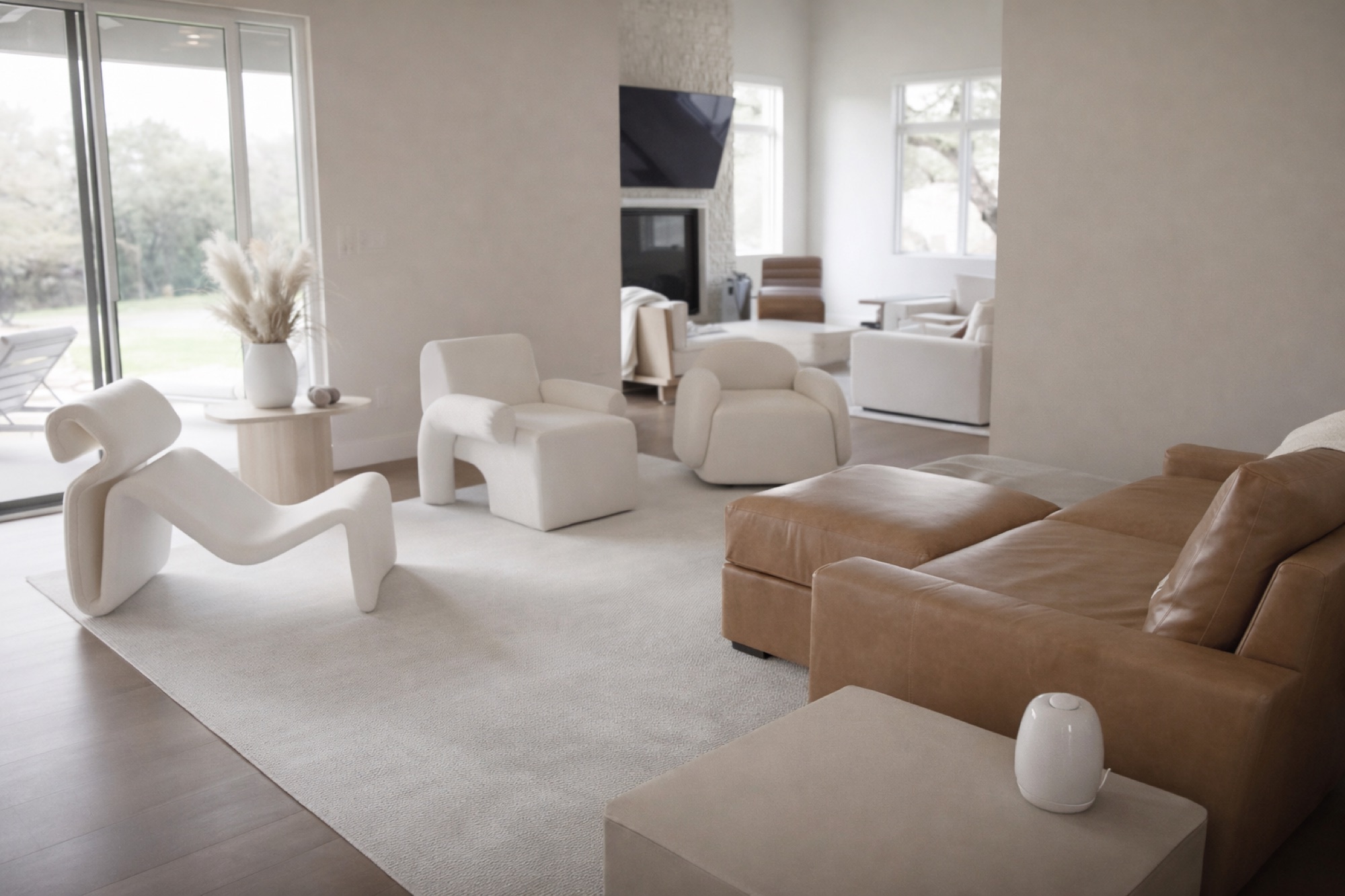
Kayla Barnes-Lenz's Austin Longevity House
A full home 25 minutes outside Austin, designed around measurement and subtraction. Kayla Barnes-Lenz's residence documented room by room — lighting, air, water, sauna, bedroom, and the products that make it work.

Ben Greenfield's Idaho House
A 10,000-square-foot biohacking house on family land. Copper under the floors, ethernet in every room, a $150K red-light chamber downstairs — designed as generational infrastructure, not a wellness flex.
Related Protocols
Practices in the directory that run on the home's light system.
Morning Light Exposure
Bright light early in the day, used to anchor circadian timing — the foundation the rest of the sleep stack sits on.
Wind-Down
A fixed pre-sleep sequence that removes light, heat, and stimulation in order, so the end of the day looks the same to your body every night.
Evening Light Reduction
Dimming the house on a schedule so the last hours of the day stop reading as noon — the other half of morning light.
Red Light Therapy
Structured red and near-infrared light exposure — wavelength, distance, duration, and frequency, without the marketing.
Key Takeaways
- Light is a system with a daily schedule, not a collection of fixtures — the goal is a house that agrees with the sun about what time it is.
- Daylight first. Orientation, window placement, and shading do more than any fixture, and using the bright side of the house in the morning is free.
- Build in layers — ambient, task, accent, indirect — each dimmable, instead of one bright layer straight down.
- Bright days, dim warm evenings, dark nights. The circadian evidence is consistent, and screens count as fixtures.
- Fixture quality is mostly invisible on the spec sheet people read: color rendering and flicker-free dimming separate good light from cheap light.
- Controls make it stick. Scenes and automation exist so the right light happens on the nights nobody is thinking about it — and construction is the cheap time to plan for them.
Sources
- Brown et al., Recommendations for daytime, evening, and nighttime indoor light exposure to best support physiology, sleep, and wakefulness in healthy adults (PLOS Biology, 2022)
- Gooley et al., Exposure to room light before bedtime suppresses melatonin onset and shortens melatonin duration in humans (J Clin Endocrinol Metab, 2011)
- Chang et al., Evening use of light-emitting eReaders negatively affects sleep, circadian timing, and next-morning alertness (PNAS, 2015)
- Wright et al., Entrainment of the human circadian clock to the natural light-dark cycle (Current Biology, 2013)
- NIH National Institute of General Medical Sciences, Circadian Rhythms
- IEEE Std 1789-2015, Recommended Practices for Modulating Current in High-Brightness LEDs (flicker)
- Whole Building Design Guide (NIBS), Daylighting