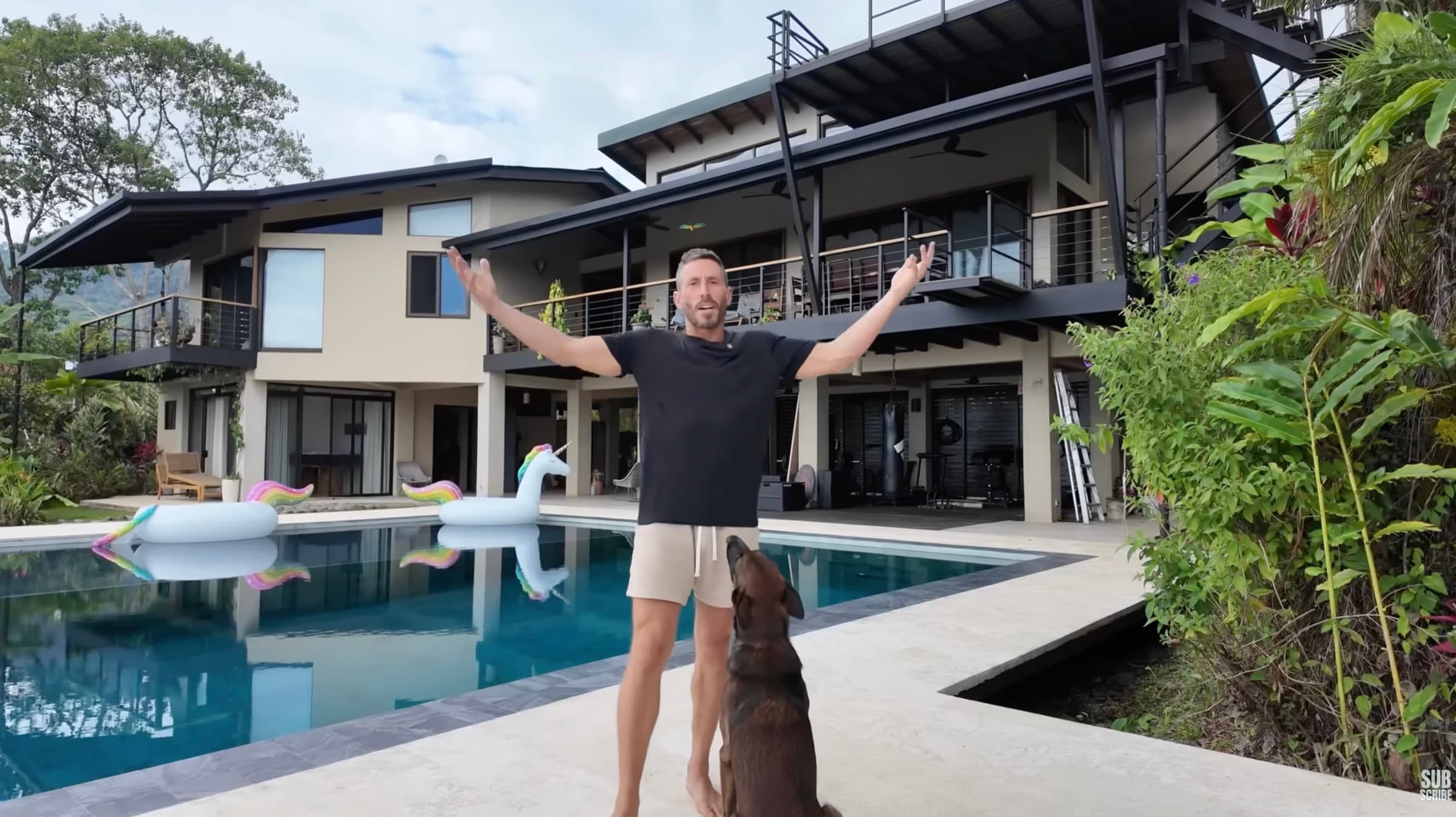
On a Costa Rican ridgeline, in a house with a 21-foot diving platform bolted to the roof, a skate ramp carved into the hillside, and a rat's nest of ethernet cables the owner calls "abstract art." It belongs to Paul Saladino — the carnivore-adjacent MD, ex-vegan, current professional contrarian.
It's less a wellness compound than a bachelor pad that happens to take light, water, and EMF very seriously. Paul's word for it, not ours: treehouse.
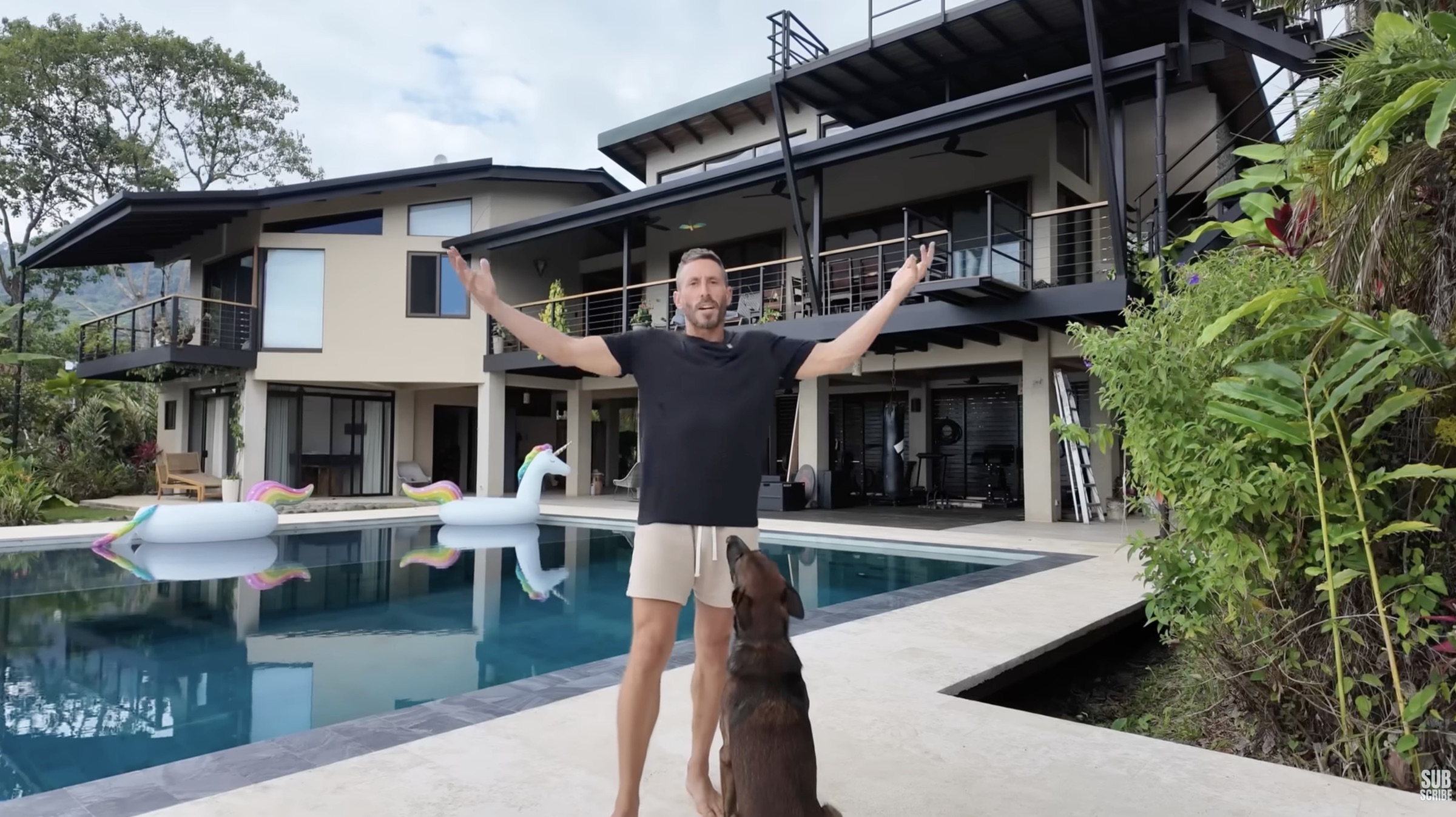
Jungle and ocean at the same time. River below, Pacific in the distance, no neighbors visible past one farm across the ridge. The house sits in the canopy with a 12-foot ozone pool cantilevered off the deck and a diving platform up top. Windows open. Breeze through. A diesel Ford Raptor out front for beach runs and river crossings — no EVs on the property. Paul's reasoning: diesel lasts longer.
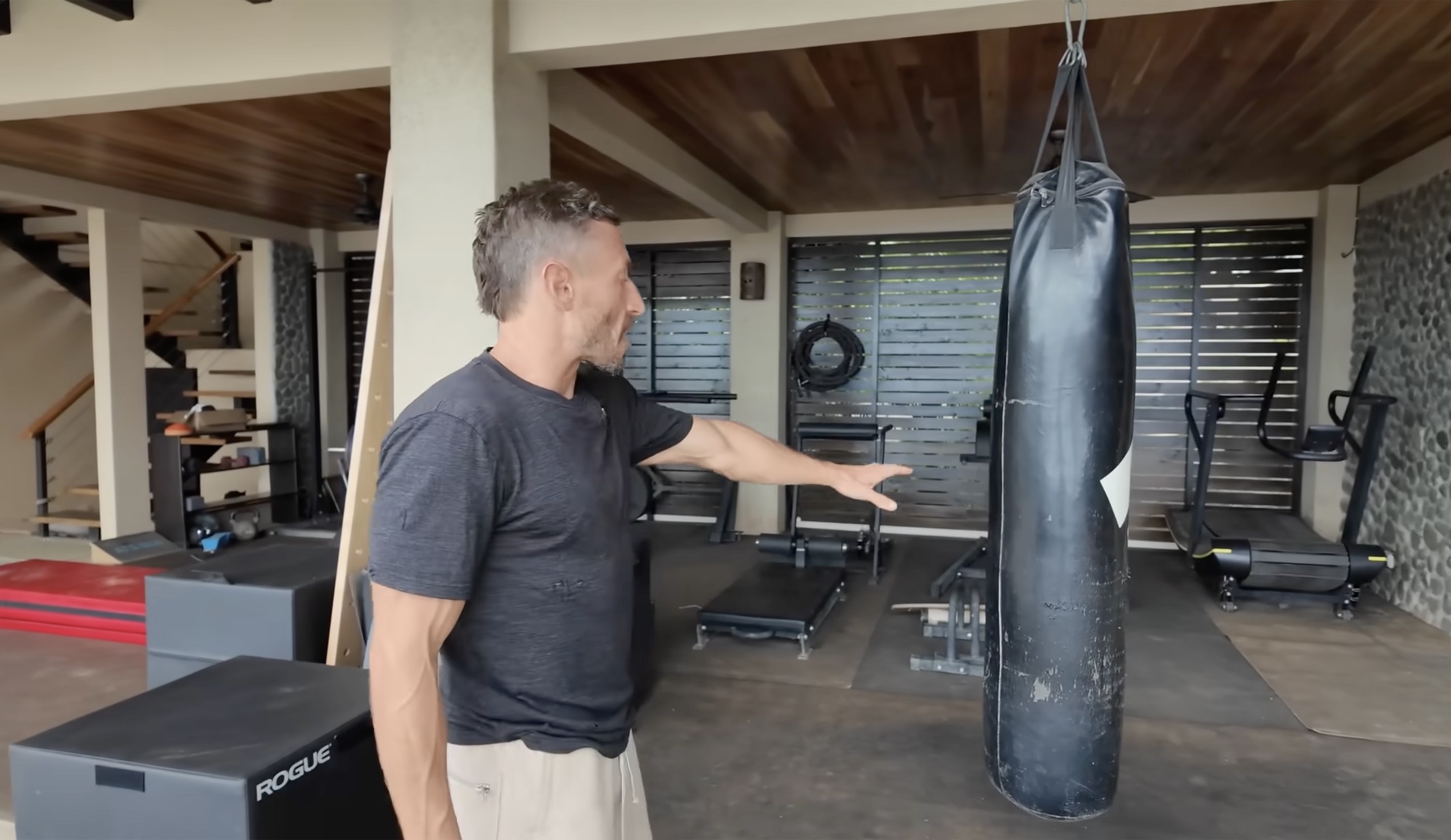
The Outdoor Gym
On the ground level, half-covered, half-open. Deliberately outdoors — Paul won't train under LED lights if he doesn't have to, and the open-air setup means infrared and UV even on shade days.
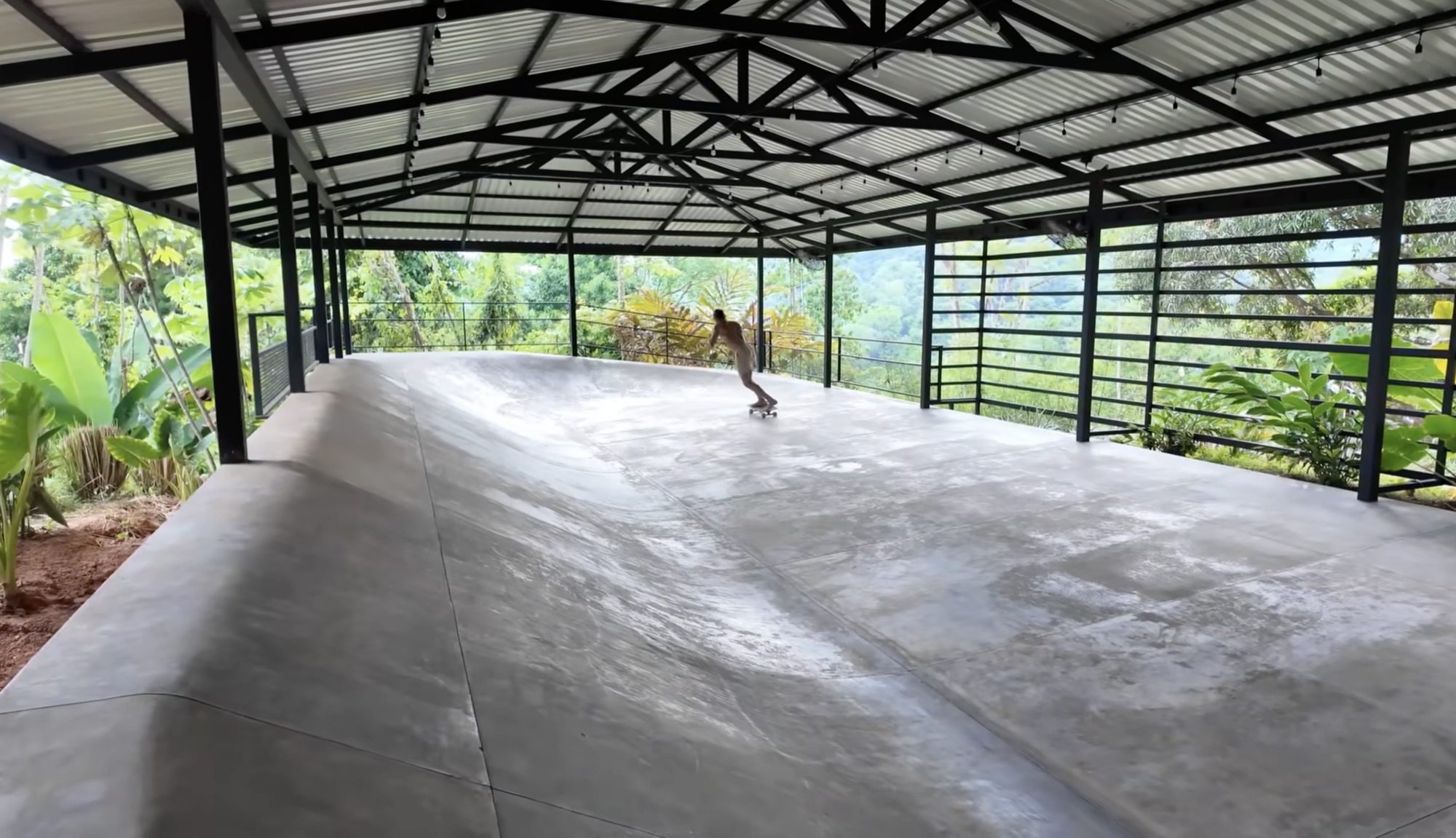
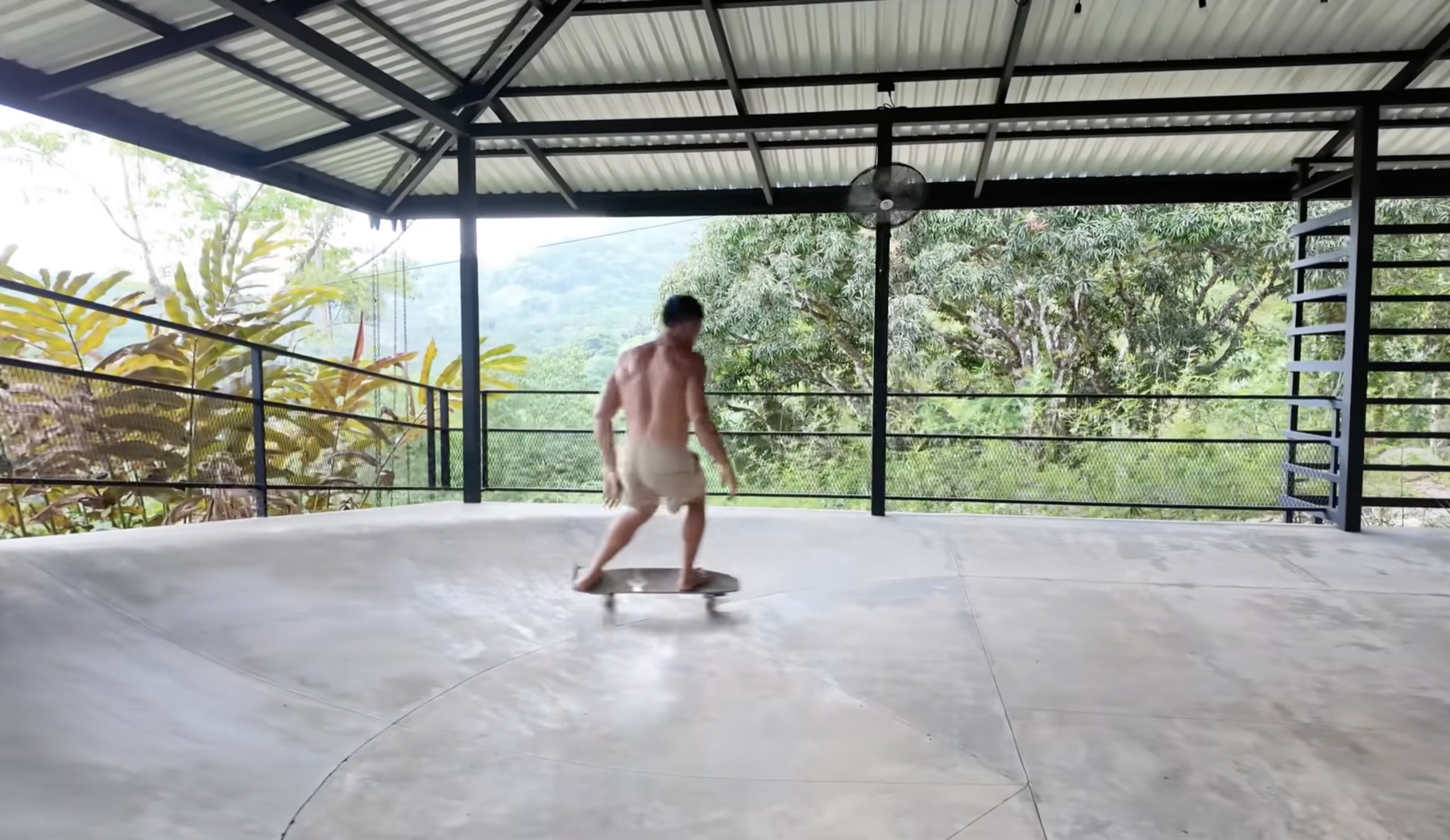
Down the hill: a half-pipe skate ramp with an ocean view and a martial-arts mat setup. Zach, a two-year-old raw-fed Belgian Malinois, patrols.
The Kitchen
Wood counters, wood cutting boards, wood everywhere. Not durable. Looks great. Paul's fine with the trade.
The zero-plastic rule runs deep. Blending happens in a stainless-steel Vitamix — metal path only, nothing plastic in the container. Cookware is stainless today, with ceramic-coated cast iron on the shortlist. Cleaning is stripped to two ingredients: baking soda for dishes, vinegar (sometimes spiked with baking soda) for laundry. No detergent, no dyes, no fragrance anywhere in the house.
Inside the fridge, the inventory reads like a punchline: honey, honey, honey, more honey. Raw cow's milk with a visible cream line. Lineage Provisions creatine, beef tallow, and an animal-based meal replacement. Heart & Soil Whole Package (testicle and liver) and colostrum. Grass-fed 80/20 ground beef. Bone broth. Several pounds of butter — "you can never have too much." Diamond Crystal kosher salt. Cut cantaloupe, oranges for juicing, cucumbers, squash, and a soursop Paul pulled off a tree in the yard that morning.
No sauces. No condiments. No processed anything. A SIG Sauer replica airsoft gun sits on the counter — it fires infrared lasers at a target across the room, for indoor practice. He's not shooting great today.
The Ethernet Situation
The most unusual thing about this house isn't visible from the outside. It's the absence of Wi-Fi.
Paul runs zero RF EMF through the walls. A physical ethernet cable snakes from the router to his laptop and, yes, directly into his iPhone via a lightning-to-ethernet adapter. The phone stays in airplane mode permanently. Bluetooth and Wi-Fi toggles are fully off — not just "disconnected," because on iPhone, a gray icon means the radio's still alive and quietly transmitting.
The result: he can still stream Spotify and podcasts with the phone functionally dark. Full internet, zero ambient RF.
Would he do it again? Yes — but with the cables run inside the walls. The current setup looks like a server closet threw up. He's embraced it. Calls it a sculpture.
The Living Room
All-wool rugs, all imported — no polyester, nothing to shed microplastics into the air. The couch is wool too; Paul calls it the most comfortable he's ever owned. Custom stained teak doors added after the build are the detail that quietly runs the room.
On the walls, a Banksy print and a reproduction of the Lascaux cave paintings. A 600-pound slab of petrified wood on display. Rick Rubin's The Creative Act open on the table. Out on the deck, a stainless-steel grill does most of the actual cooking.
The Bedroom
Simple on purpose. A natural mattress (no polyester, no off-gassing), organic cotton sheets, a ceiling fan. No air conditioning — Paul doesn't trust it not to harbor mold in the tropics. A red light panel in the corner, used occasionally. Mostly he just goes outside.
The detail worth copying: a grounding mat on the bed, wired not to an outlet but to a three-meter copper stake driven into the actual dirt beside the house. This is how grounding mats are supposed to work. Plugging one into a wall socket pipes dirty electricity straight into the bed — defeating the point. The copper stake bypasses the grid entirely and connects directly to earth.
The Pool (And the Platform)
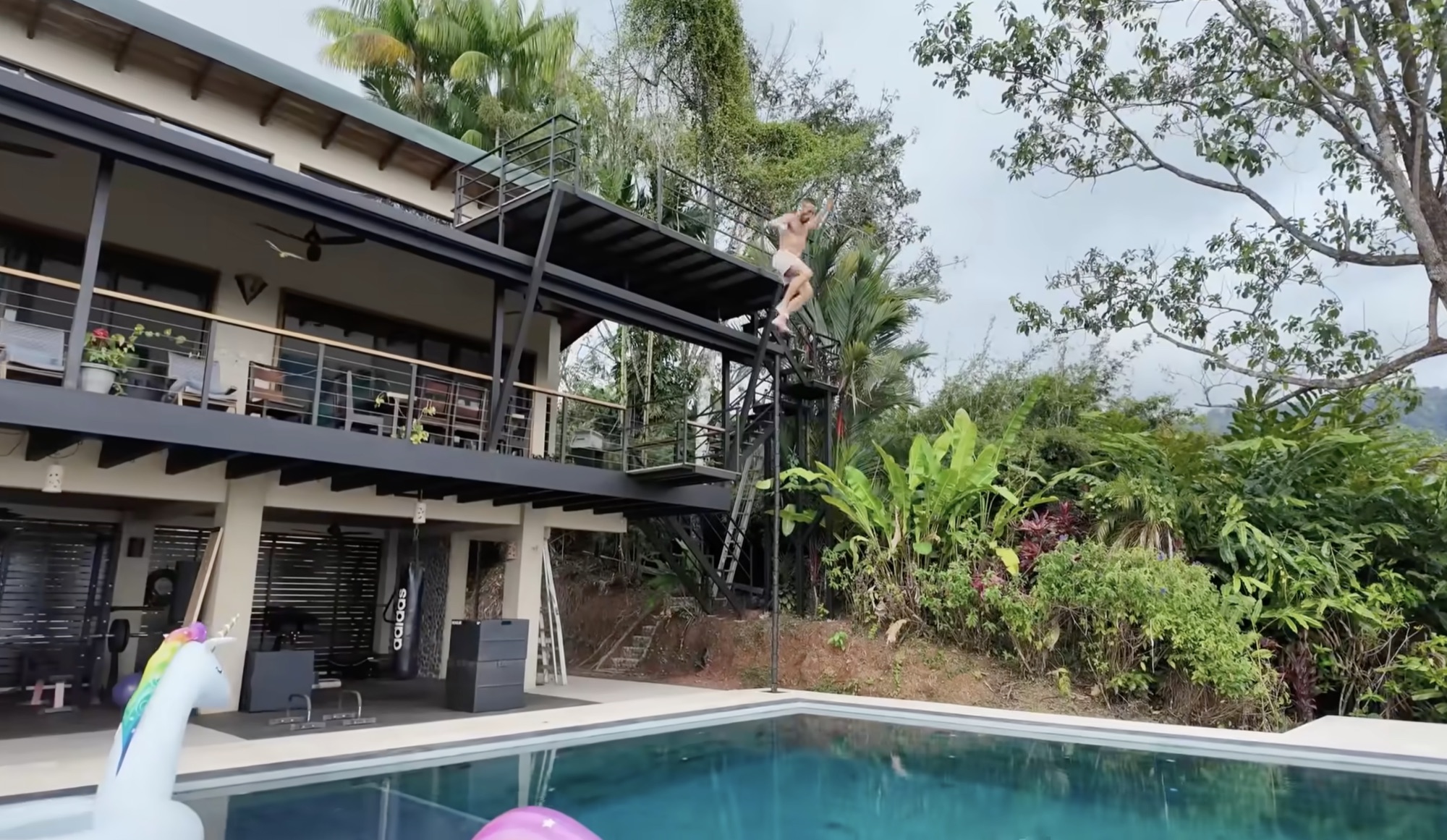
The pride of the build. Twelve feet at its deepest point, cleaned entirely with ozone — no chlorine. A 21-foot diving platform sits on the roofline above. Costa Rica keeps the water around 85°F naturally; the adjacent infinity-style hot tub climbs to 104°F when he wants it.
The deep end mostly gets used for static breath holds — sometimes with 20-pound weights on the bottom, walking the floor à la Laird Hamilton's training protocol. Never alone, never after hyperventilating. That's how people die, in Paul's words.
The Yard
Stingless Mariola bees in a hive on the way down to the skate ramp — the honey is reportedly unreal, and he's only ever seen them in Costa Rica. Wild fruit trees: guanabana (soursop), coconut, starfruit, all within walking distance of the kitchen. The soursop on the counter came off a tree he can see from the half-pipe.
What's Actually Worth Stealing
Paul's house isn't a blueprint you can copy in Brooklyn. Strip away the jungle and the diving platform, though, and there's a surprisingly portable list.
- 1Ethernet over Wi-Fi where you can. One cable to your desk, one to your phone, airplane mode the rest of the day. Cheapest EMF upgrade there is.
- 2Ground into actual dirt, not an outlet. If you have a yard, a copper stake in the ground is a $30 fix that does what a plug-in mat pretends to.
- 3Swap the washing-machine chemistry. Vinegar and baking soda. Clothes don't smell. Skin thanks you.
- 4Filter the shower, not just the sink. If you're on city water, the shower is where most of the chlorine and chloramine exposure lives — inhaled and absorbed through skin. A $50 inline filter covers what your drinking setup doesn't.
- 5Convert the pool to ozone or UV. Chlorine is absorbed through skin every time you swim. If you own a pool, this is the upgrade.
The Throughline
The Saladino house doesn't try to be perfect. It's got exposed cables, a bench press nobody uses, and a punching bag on its last legs. The philosophy underneath it, though, is sharp: cut the stuff actively working against you, then go outside. Sun, salt water, movement, food you can trace to a tree or an animal. The tech is there to subtract problems, not add features.
The throughline isn't the gear. It's the principle — and the principle is portable. You can strip this house down to a studio apartment and most of it still holds: hardwire what you can, ground what you can, swap the cheap plastics out one at a time, and spend more of the day outside than inside.
Original video
Costa Rica house, pool, outdoor gym, and no-Wi-Fi setup
The source tour is embedded here for context; original credit and the YouTube page are linked below.
Compound commentary and curation. Original video, facility tour, and source imagery by Paul Saladino.
More Builds:
All Builds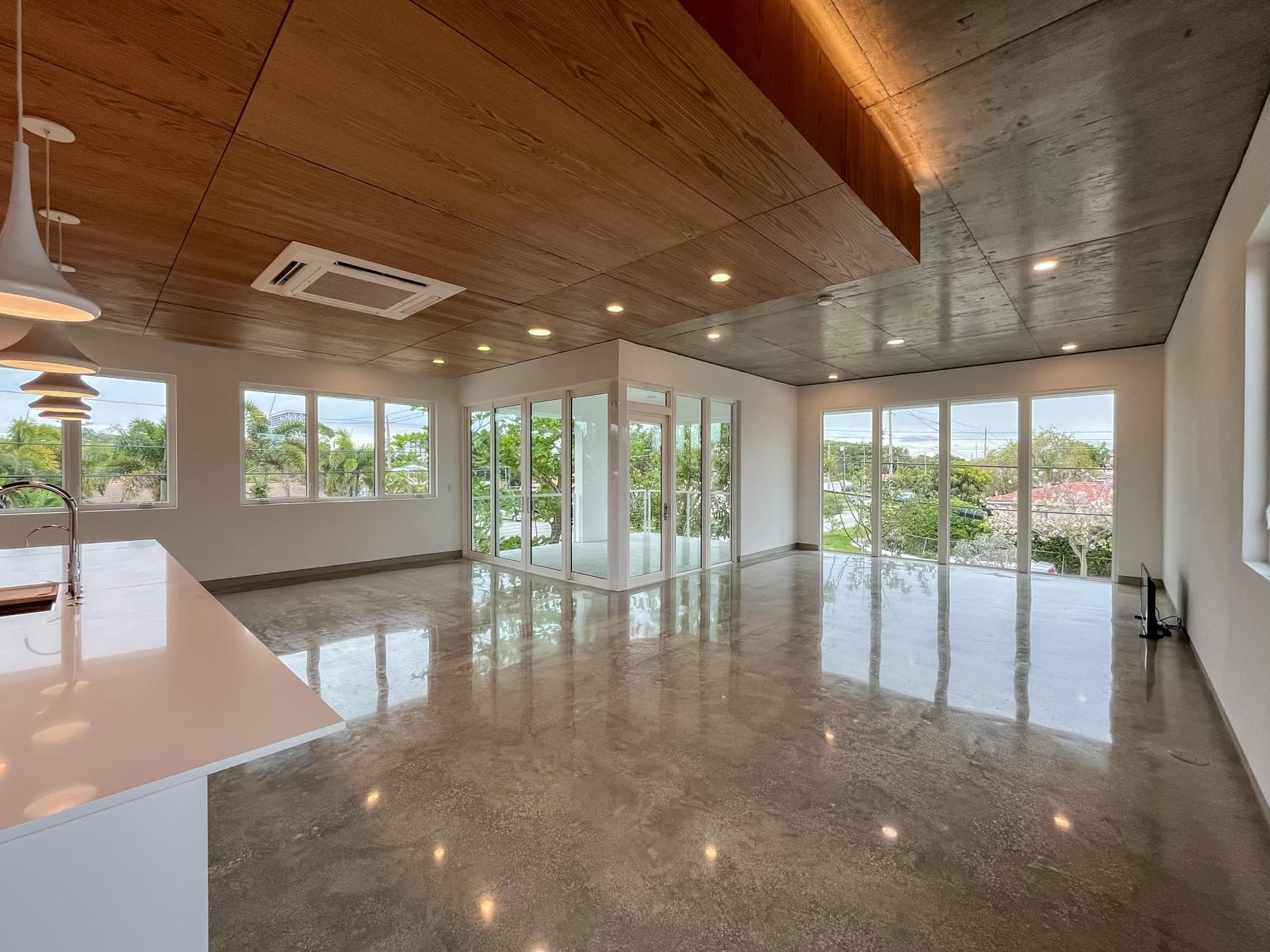
The Miami Home That Became the World's First WELL Residence
The first house on earth certified under WELL's residential standard — built in Miami with no drywall, no AC ducts, and every pipe reachable behind removable formaldehyde-free oak panels, on columns ten feet above a flood-prone city.
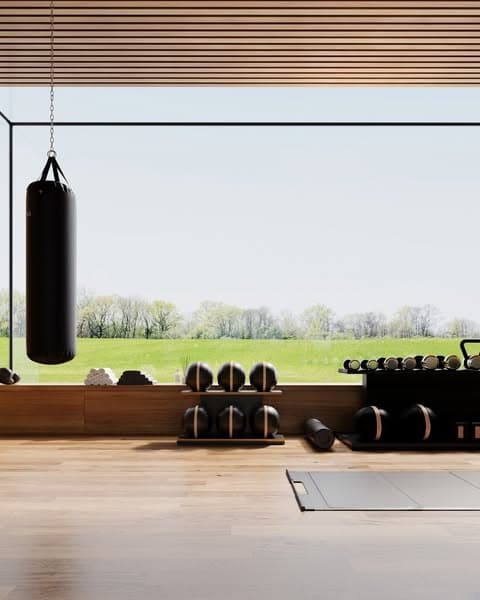
A Modern English Countryside Gym
A luxe home gym at a modern estate in the English countryside, designed by Sportova — warm oak slats wrapping the walls and ceiling, a full wall of glass onto rolling green, and sculptural weights and yoga equipment by PENT.

Greg LaVecchia's Custom Gym and Training Property in Austin
A custom green-and-leather home gym from the founder of Bloom Nutrition, backed by a wood-burning backyard sauna, a cold plunge, a recovery room with red light and hyperbaric oxygen, and three central Austin lots stitched into a private park.