
Why Residential Air Quality Matters
A well-built modern house is a tight house. Airtightness is what makes it efficient, quiet, and comfortable — and it is also what makes air quality a design problem rather than an accident. The EPA's research has found indoor concentrations of some pollutants running two to five times higher than outdoors, and Americans spend roughly 90% of their time inside. An older, leaky house ventilated itself by accident. A tight one holds whatever it generates until something is designed to remove it.
What a house generates is a specific list: fine particulate matter (PM2.5) from cooking, combustion, and outdoor infiltration; volatile organic compounds (VOCs) off-gassing from paints, adhesives, and composite wood; nitrogen dioxide from gas appliances; moisture from showers, laundry, and occupants; radon from the soil in some regions; and carbon dioxide from the people breathing in it. These behave differently and are controlled by different systems, which is why no single purchase solves “air.” The health stakes are real but uneven — long-term exposure to fine particulate is associated with cardiovascular and respiratory harm in a large body of research, while some other indoor exposures are mostly comfort and building-durability problems.
The order of operations is settled. The EPA organizes indoor air improvement around three moves, in order: control the sources, ventilate, then clean the air that remains. Equipment is the third step, not the first. This guide follows that order — how the house is designed and operated, not what to add to the cart.
The Numbers
Source Control
The cheapest pollutant to remove is the one that never enters the air. The EPA calls source control usually the most effective way to improve indoor air, and it is the step most projects skip because there is nothing to install. It happens in the spec book and the appliance schedule.
Materials. Paints, adhesives, sealants, and finishes are the largest controllable VOC sources in a new build or renovation, and low-emission versions of all of them exist at little or no premium. Composite wood — cabinet boxes, shelving, subfloor — is the main formaldehyde source; in the US, TSCA Title VI sets emission limits for it, so specifying compliant or no-added-formaldehyde product is a paperwork decision, not a hunt. Compound's materials reference covers the specifics by material.
Combustion. Gas ranges produce nitrogen dioxide and fine particulate at the single point in the house closest to your face while cooking; the EPA's guidance on indoor NO₂ is blunt about the exposure. A range hood ducted to the outside — not a recirculating one — is the highest-value single intervention in most kitchens. Beyond the range: sealed-combustion or electric mechanical equipment, no unvented gas heaters or fireplaces, and an air-sealed wall between an attached garage and the living space so exhaust and stored-fuel vapors stay out.
Radon. Regional, radioactive, and invisible to every consumer air-quality monitor's default sensors. The EPA recommends testing every home — the test costs less than dinner. In new construction, a passive radon rough-in under the slab costs little and makes later mitigation trivial; retrofitting one after the fact does not.
Moisture is a pollutant source too — the one that grows mold — but it gets its own section below, because it is controlled by different equipment than the rest of this list.
Ventilation
Ventilation replaces indoor air with outdoor air. Filtration cleans what is already there; only ventilation removes what filters can't touch — carbon dioxide, moisture, odors, and the accumulated soup of low-level gases a filter ignores. In a tight house this has to be mechanical and continuous. ASHRAE Standard 62.2 sets the whole-house rates residential systems are designed to; the building-science shorthand is “build tight, ventilate right.”
There are three ways to do it. Exhaust-only — continuous bath fans, essentially — is cheap but depressurizes the house and pulls its makeup air through random gaps in the envelope, unfiltered. Supply-only pushes filtered air in and leaks it out. Balanced ventilation moves equal air in and out through dedicated ducts, and adding a heat-exchange core makes it affordable to run year-round: a heat recovery ventilator (HRV) transfers heat between the outgoing and incoming airstreams, and an energy recovery ventilator (ERV) transfers heat plus some moisture. Balanced with recovery is the high-performance default. HRV suits cold, dry climates; ERV suits most others because it moderates the humidity swing in both directions.
One correction worth making explicit, because the opposite claim is common: an ERV is not dehumidification. It reduces the moisture load of incoming air relative to a plain fan, but in a humid climate the house can still accumulate more moisture than the ERV rejects. High-performance homes in the Southeast and Gulf states routinely need dedicated dehumidification alongside the ERV — plan for both, not either.
Reference systems. Zehnder's ComfoAir Q450 is the unit that shows what whole-home balanced ventilation looks like done properly: dedicated supply and extract runs to every room, quiet operation, and heat recovery the manufacturer rates at up to 95%, with outdoor-air filtration listed at F7 — roughly MERV 13 — so incoming air arrives pre-filtered (all manufacturer specifications). The ComfoAir 70 is the single-room version for apartments and retrofits: a through-wall unit that moves supply and extract air simultaneously through a cross-counterflow enthalpy exchanger, giving one room continuous balanced ventilation without a duct system.
And the window? It works — for CO₂, when the outdoor air is decent and the weather is mild. What it costs is conditioning, filtration, and sound control, which is why it is a useful tool and a poor system. In wildfire season or next to a busy road, it is the wrong tool entirely.
Systems in the Directory
Filtration
Filtration removes particles. That's the whole job — and the boundary matters, because a filter does nothing for CO₂ and little for most gases unless it carries a separate carbon stage. Ventilation and filtration are complements: one dilutes what the other can't capture. A stuffy room needs air exchange; a smoky one needs a filter.
Central filtration. If the house has ducted heating and cooling, the air handler's filter slot is the cheapest filtration upgrade available. MERV ratings grade how much a filter captures; MERV 13 catches a meaningful share of PM2.5 and is the grade worth specifying where the blower can handle the added resistance — worth a conversation with the HVAC contractor rather than an assumption, since an overtaxed blower moves less air. Put filter access somewhere a person will actually reach, and change on schedule: a loaded filter chokes airflow before it stops filtering.
Portable HEPA units. A true HEPA filter captures 99.97% of particles at 0.3 microns, the hardest size to trap; larger and smaller particles are caught at higher rates. Sizing is the decision that matters: match the unit's clean air delivery rate (CADR) to the room, per the EPA's air cleaner guide, and run it continuously on a low speed rather than occasionally on high. One caution with the category: avoid ozone-generating devices sold as purifiers — ozone is itself a respiratory irritant.
The units in the directory each illustrate a corner of the category. IQAir's HealthPro Plus is the heavy-duty standalone — dense HEPA media plus a gas-phase carbon stage, with filtration the company rates down to 0.003 microns. The Atem X is IQAir's slimmer large-room unit. Dyson's Purifier Cool folds HEPA filtration into a fan with onboard sensors and a live readout. Molekule's Air Pro pairs a particle filter with its PECO process, which the company claims breaks pollutants down rather than trapping them — treat that as a commercial claim; the HEPA-grade capture is the part you can count on.
Purifiers in the Directory
Humidity & Moisture
The working target: aim for roughly 30–50% relative humidity where practical and keep it below 60%, while accounting for climate and condensation risk. That band comes from building science more than biology — the EPA's mold guidance draws the upper line at 60% because sustained dampness is what feeds mold, and the WHO's dampness and mould guidelines document the respiratory harms of damp buildings and note that dust mites need humidity above roughly 45–50% to thrive. The high side of the band is the well-evidenced side.
Control the sources before the setpoint. Bath fans ducted outside and run past the end of the shower. The dryer vented out, not into the mechanical room. Gutters, grading, and ground moisture handled at the envelope. Most humidity problems are moisture-source problems wearing a disguise, and no appliance out-runs a wet foundation.
Humid climates: plan dedicated dehumidification. As covered above, the ERV moderates incoming moisture but does not remove what the house accumulates. A whole-house dehumidifier tied into the ductwork holds a setpoint through the shoulder seasons when the air conditioner isn't running long enough to wring anything out; a standalone unit with a condensate drain covers a basement.
Cold climates: condensation caps the target. In winter, the limit isn't comfort, it's the coldest surface in the room. Run 50% humidity against single-pane glass or a poorly insulated corner in January and the water lands there, then the mold does. Drop the winter setpoint as outdoor temperature drops, and treat condensation on windows as the signal you have exceeded what the envelope tolerates. Humidifying dry winter air is reasonable below about 30% — the health evidence for going higher is thinner than the marketing suggests. The operational detail lives in the indoor humidity control protocol.
Monitoring & Testing
Every system above is invisible when it works, which is why measurement is the part of the stack that keeps the rest honest. The useful mindset is that each sensor answers one narrow question — and knowing which question is most of the skill.
CO₂ answers the ventilation question — and only that one. Outdoor air sits around 420 ppm; an occupied room that stays in the high hundreds is exchanging air adequately for the people in it, and one that climbs into sustained four-figure territory overnight is not. ASHRAE's position document is explicit that indoor CO₂ is not a general measure of air quality: a low reading says nothing about particulate, radon, or formaldehyde, and there is no single threshold that separates good air from bad. What the research does support is the direction — field studies in bedrooms found that increasing overnight ventilation improved measured sleep quality and next-day performance, and controlled office studies have associated better-ventilated conditions with higher cognitive test scores. These are small studies, and CO₂ in them may be a marker of stale air rather than the cause. Treat the number as a ventilation gauge, not a verdict.
The rest of the panel. PM2.5 sensors in consumer monitors are decent, and watching one spike during searing tells you more about your range hood than any spec sheet. TVOC sensors are rough, relative instruments — useful for trends (something new is off-gassing) and useless as absolute readings. Humidity sensing is cheap and worth having in more than one room. And radon needs its own test — a long-term one, since levels swing seasonally. Monitor makers like Airthings build radon sensing into their home units, which is the practical way to keep watching after the initial test.
Where to put them: the bedroom first — it's the room with the most exposure hours and usually the worst overnight ventilation — then wherever people work with the door closed. A week of data will reorder your assumptions about which rooms have a problem.
Room-by-Room Priorities
Rooms differ by what they generate and how many hours you spend in them. Prioritize by exposure time first, source strength second.
Bedroom. A third of your life in a small volume behind a closed door — the highest-exposure room in the house and the first one to fix. Ventilation is the lever: a supply duct from the ERV, a quiet fan, or a cracked window when outdoor air allows. Filtration earns its place when the outdoor air is the problem (pollen, traffic, smoke). Measure before buying; the overnight bedroom air protocol walks the sequence.
Kitchen. The strongest particle source in most homes. The ducted range hood is the intervention — run it every time the stove is on and for several minutes after, and use the back burners, which sit inside the hood's capture zone. A recirculating hood filters grease and returns the NO₂ to the room.
Office. One person, closed door, long hours: a ventilation problem with a desk in it. A CO₂ monitor tells you whether the room needs the door open, a transfer grille, or a supply duct. Filtration is secondary here unless outdoor particulate is high.
Home gym. Breathing rates during training multiply the dose of whatever is in the air, and gyms are often in basements and garages — the rooms with the worst baseline air in the house. Ventilate during sessions, and add filtration where the space shares air with vehicles, dust, or stored chemicals.
Basement and mechanical room. Where radon enters, moisture accumulates, and combustion equipment lives. Test for radon, keep humidity under 60% with a drained dehumidifier, and prefer sealed-combustion equipment. Unglamorous, and upstream of every other room in the stack.
Questions for Your Project Team
If you are building or renovating, air quality is decided in the mechanical plan and the spec book, months before anyone can breathe the result. These are the questions to put to the architect, builder, or mechanical engineer — each has a concrete answer, and “we'll figure it out later” is the wrong one.
What airtightness target are we building to, and what mechanical ventilation is paired with it?
Is the ventilation balanced (HRV/ERV) and ducted to the bedrooms, or exhaust-only? What ASHRAE 62.2 rate is it designed to?
HRV or ERV for this climate — and in humid months, what handles dehumidification? (The ERV alone won't.)
What filter grade does the air handler take, can the blower support MERV 13, and where is filter access?
Does the range hood duct outside? At what CFM, and does that rate require makeup air?
Is there a radon rough-in under the slab?
Are paints, adhesives, sealants, and composite wood specified low-emission (TSCA Title VI compliant or better)?
How will the ventilation system be commissioned — measured airflows room by room, not assumed from the design?
Where do the monitors go, and who hands over the operating manual for all of this?
Documented Builds
Homes in the directory where the air systems are documented room by room.
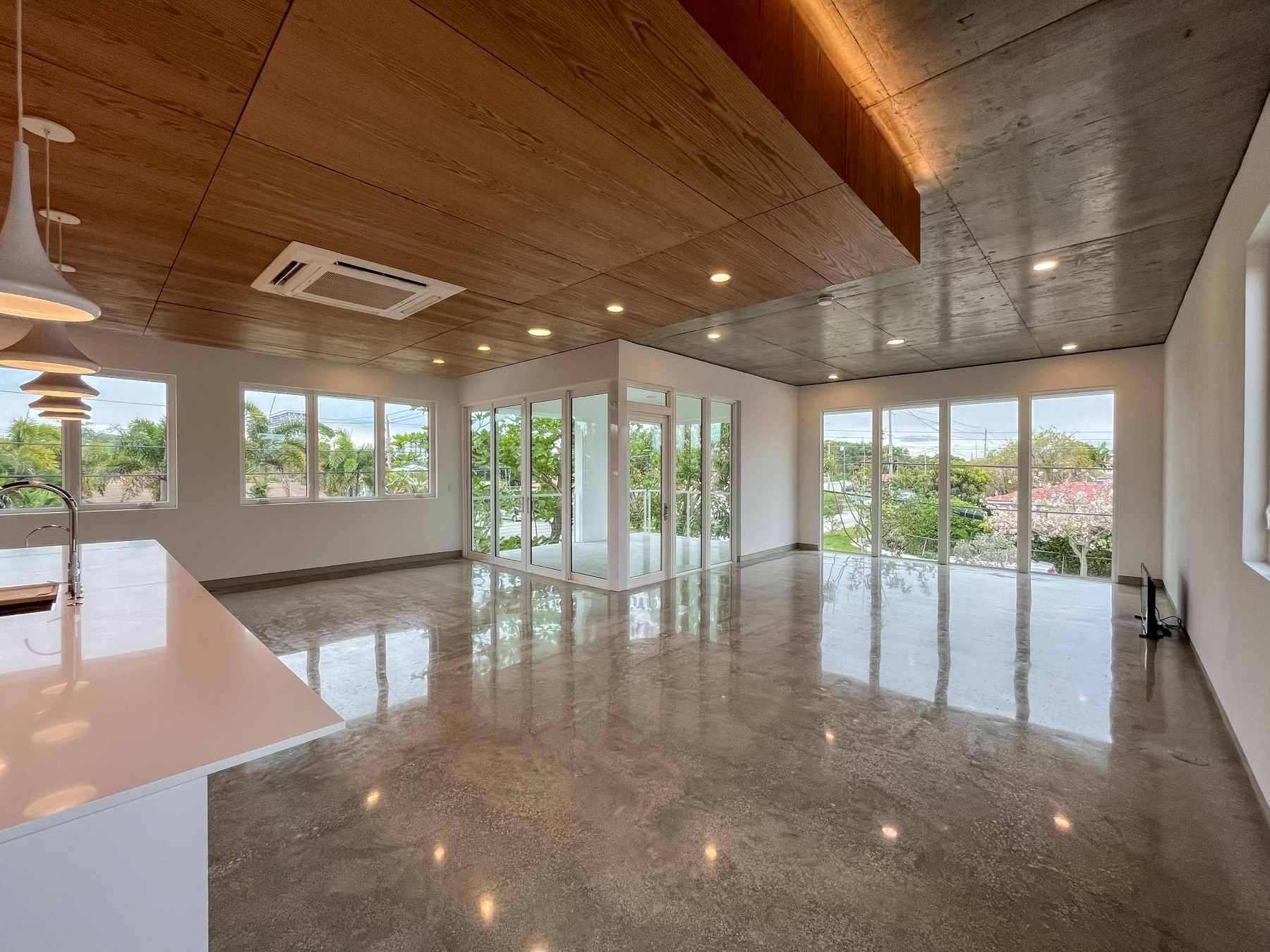
The Miami Home That Became the World's First WELL Residence
The first house on earth certified under WELL's residential standard — built in Miami with no drywall, no AC ducts, and every pipe reachable behind removable formaldehyde-free oak panels, on columns ten feet above a flood-prone city.

Ben Greenfield's Idaho House
A 10,000-square-foot biohacking house on family land. Copper under the floors, ethernet in every room, a $150K red-light chamber downstairs — designed as generational infrastructure, not a wellness flex.
Where to Start
Building or renovating: spend the money on source control and balanced ventilation while they're cheap — low-emission specs, a ducted range hood, an HRV/ERV in the mechanical plan, a radon rough-in. Everything in this guide is easier as a line item than as a retrofit.
Improving an existing house: measure first. Then fix the kitchen (ducted hood), upgrade the HVAC filter toward MERV 13 if the blower allows, put a correctly sized HEPA unit in the bedroom, and add ventilation where the CO₂ data says the house is stale.
Renting: a monitor, a portable HEPA unit sized to the bedroom, and window discipline cover most of what you control. The rest is a question for the next lease.
Sources
- U.S. EPA, The Inside Story: A Guide to Indoor Air Quality
- U.S. EPA, Improving Indoor Air Quality (source control, ventilation, air cleaning)
- U.S. EPA, Health and Environmental Effects of Particulate Matter (PM)
- U.S. EPA, Facts About Formaldehyde (composite wood products, TSCA Title VI)
- U.S. EPA, Nitrogen Dioxide's Impact on Indoor Air Quality
- U.S. EPA, Radon
- ASHRAE Standard 62.2, Ventilation and Acceptable Indoor Air Quality in Residential Buildings
- ASHRAE, Position Document on Indoor Carbon Dioxide (2025)
- U.S. EPA, Guide to Air Cleaners in the Home
- U.S. EPA, What is a MERV rating?
- U.S. EPA, Ozone Generators that are Sold as Air Cleaners
- U.S. EPA, A Brief Guide to Mold, Moisture and Your Home
- WHO Guidelines for Indoor Air Quality: Dampness and Mould (2009)
- Strøm-Tejsen et al., The effects of bedroom air quality on sleep and next-day performance (Indoor Air, 2016)
- Allen et al., Associations of cognitive function scores with CO2, ventilation, and VOC exposures in office workers (Environ Health Perspect, 2016)